How to wash silk
Can you wash silk? And how? We decided to find out. See our great silk washing test.
Full article🛠️ We are currently experiencing a minor technical glitch and you cannot reach us by phone. Please reach out to us by email. Thank you!
Product code 103-04-1004-R (2)
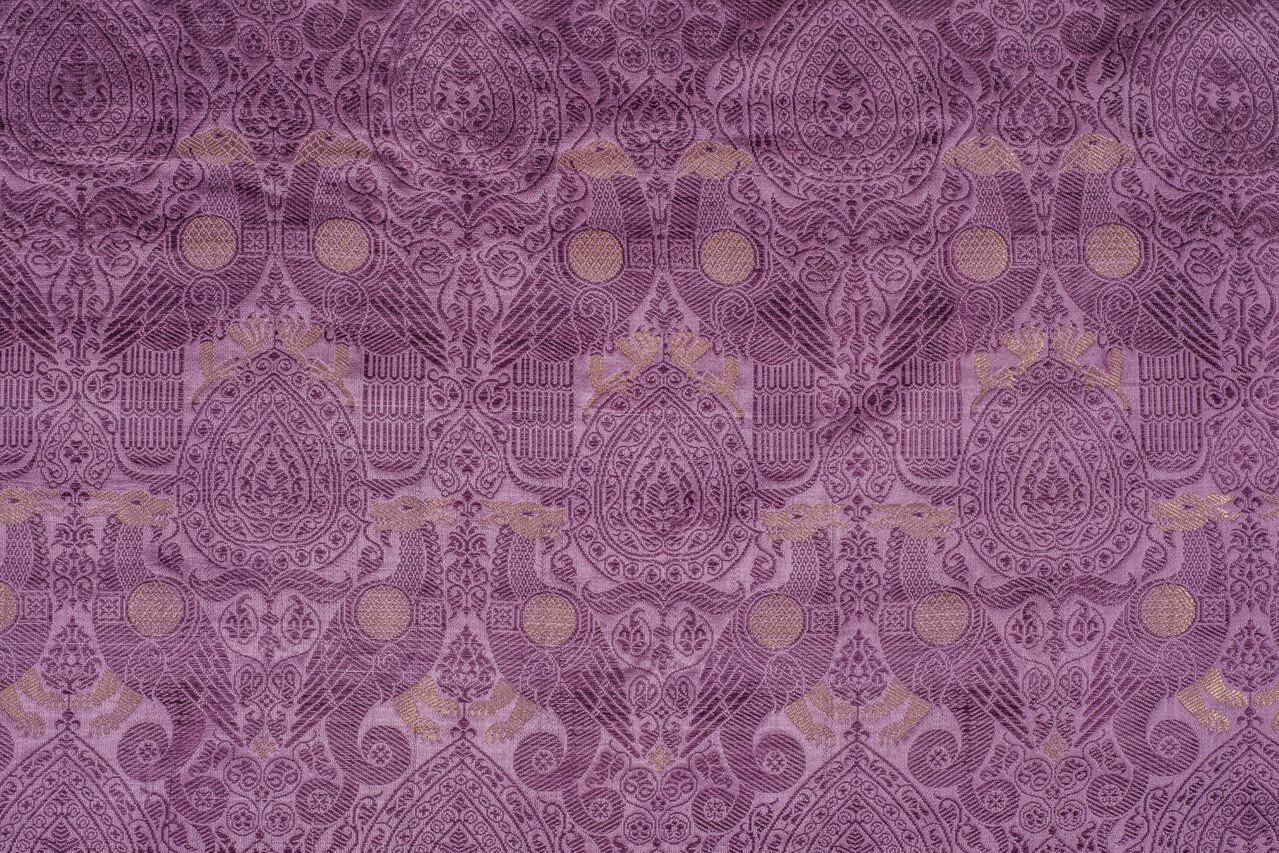
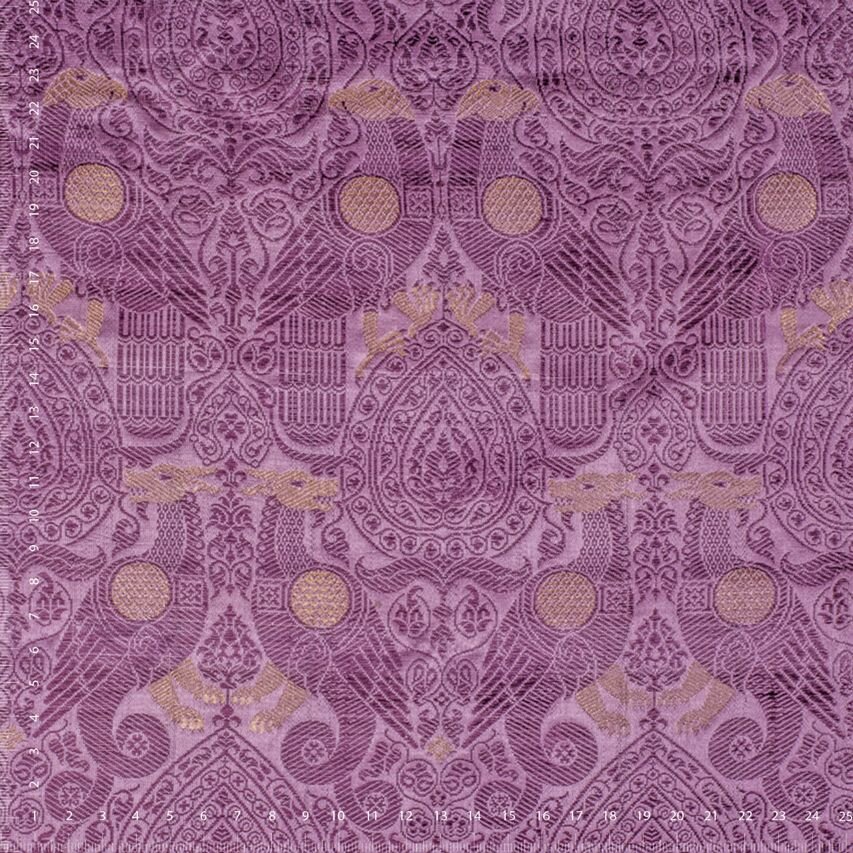
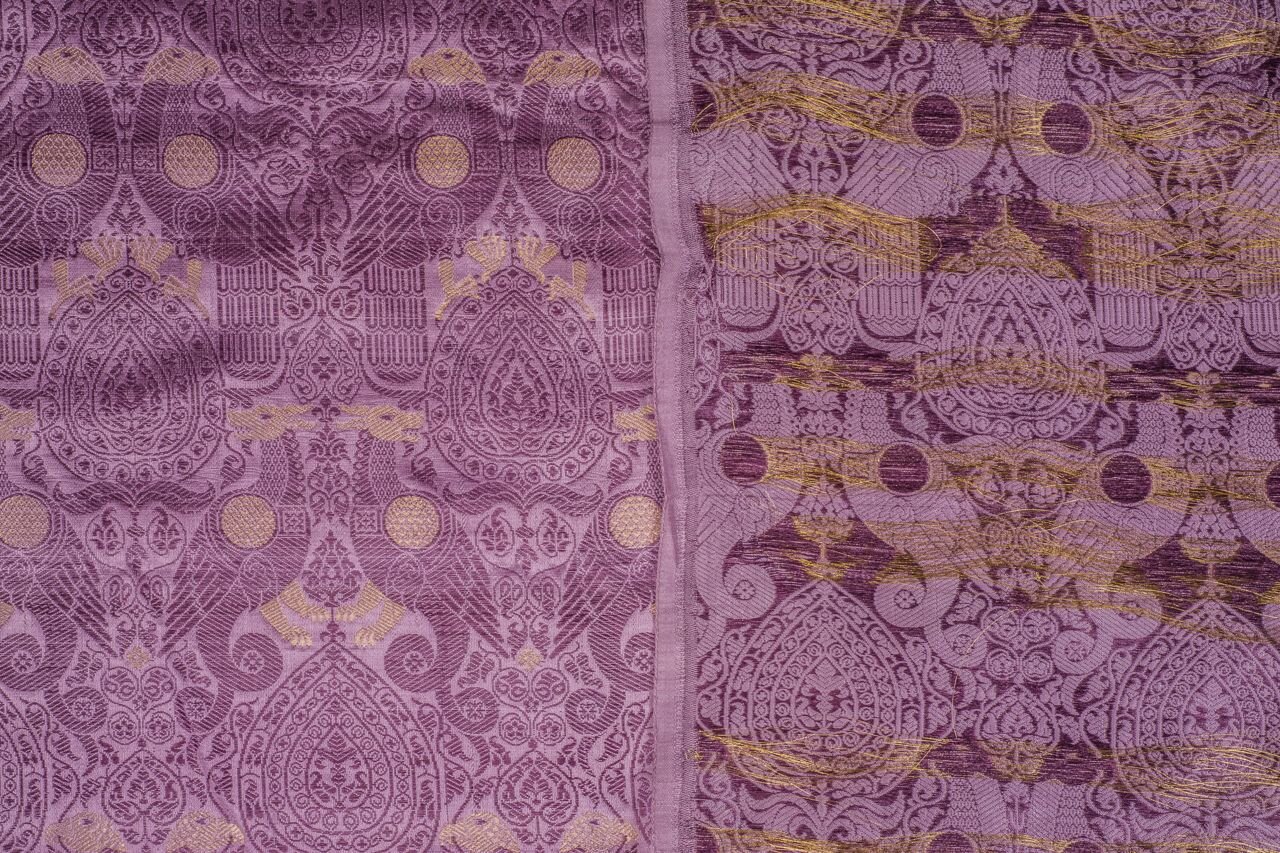
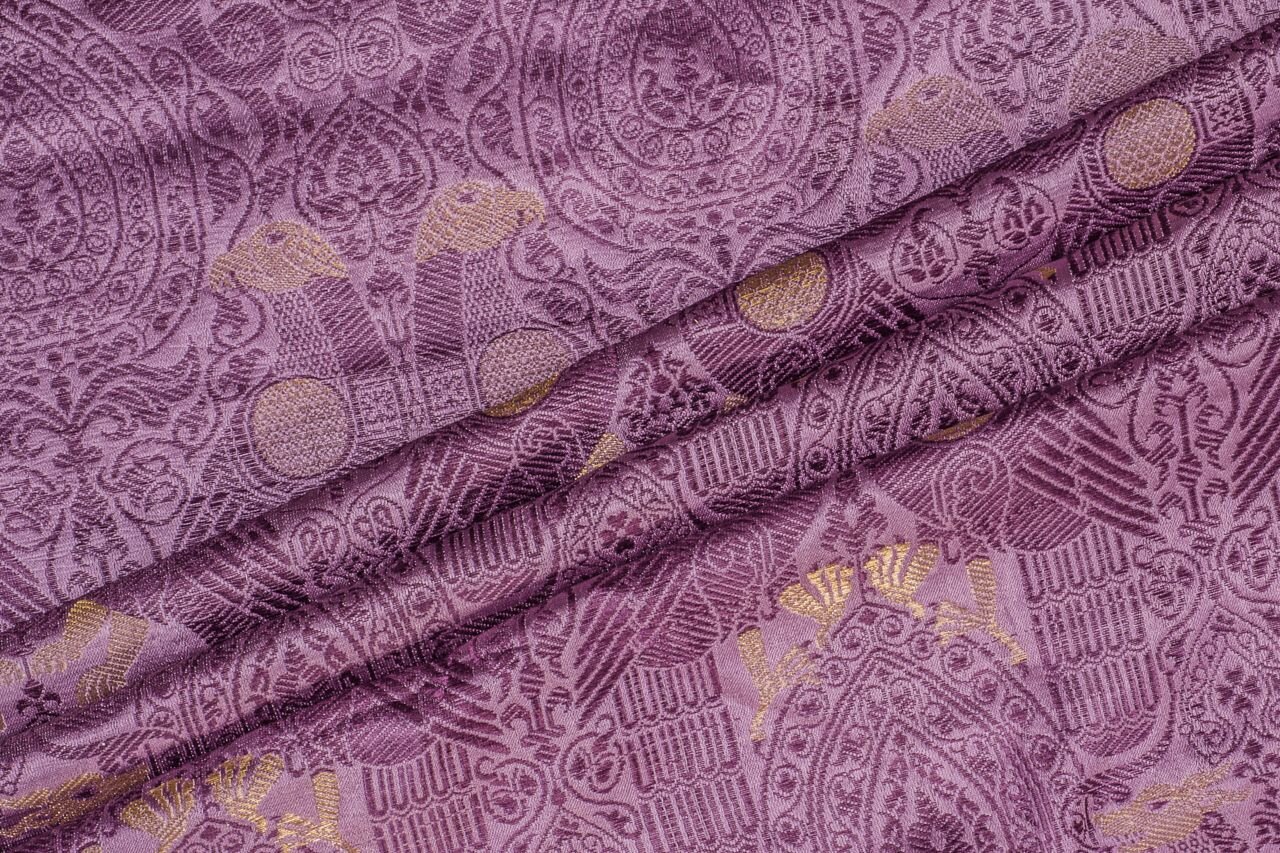
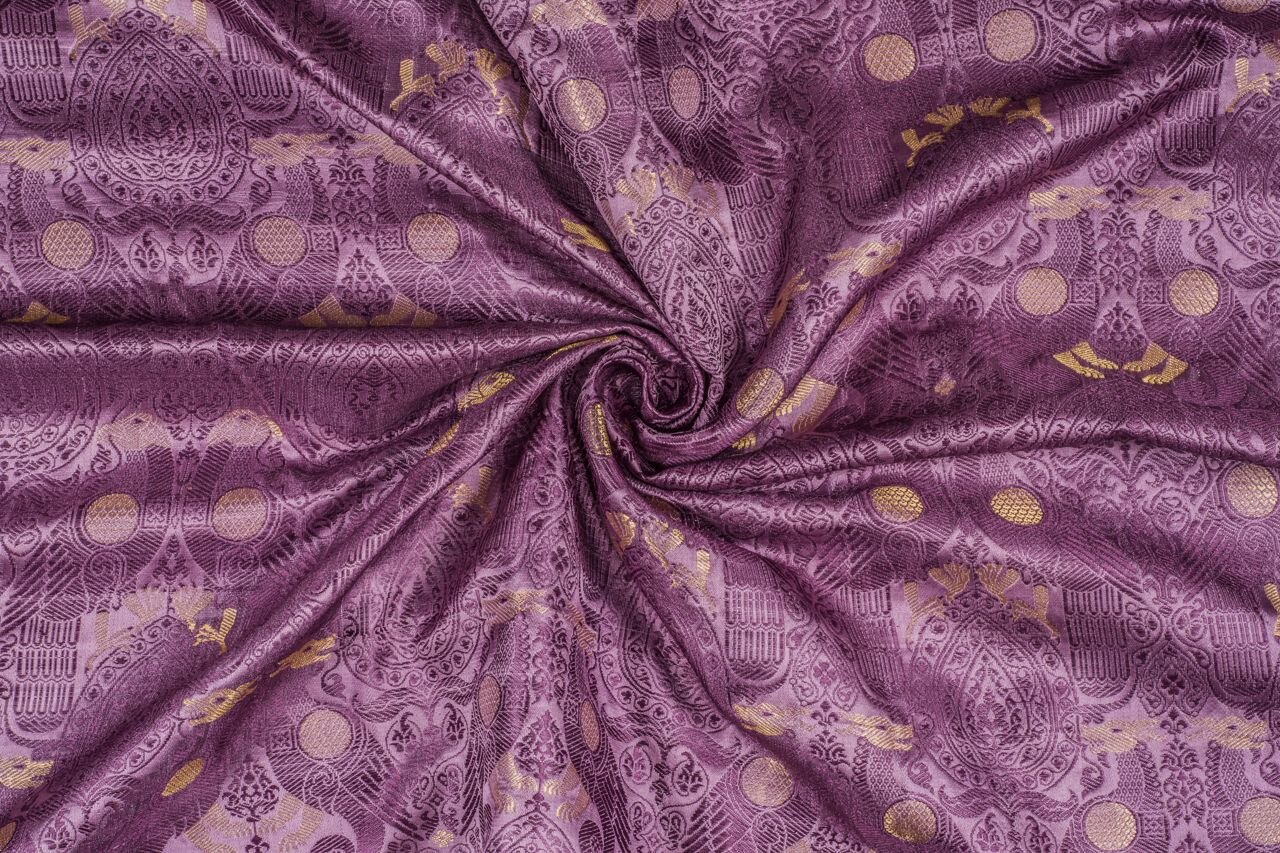
Replica of a Sicilian lampas from the turn of the 13th and 14th centuries in violet.
Read more| Shade: | violet |
| Period: | 13th–14th centuries |
| Material: | 30% metallic thread, 70% silk |
| Width (cm): |
109 cm
The useable width you can actually sew with, not including selvedge. |
| Weight (mm): | 25 mm |
| Weight (gsm): | 109 gsm |
| Pattern size: | 12 cm |
| Pattern size (vertical): | 25 cm |
| Care: | |
| Availability: | limited edition |
on order
Alternative products in the category Medieval and Renaissance:
The pattern has both animal and plant motives. Between palm trees there are pairs of eagles and special medieval beasts "scytale". Unlike the eagles, they have paws instead of claws, a snake tail, long ears and stunningly decorated back. According to the medieval bestiary, they used their scales to stun the viewer, who, fascinated by their beauty, became an easy prey. The original fabric is either of Sicilian or Spanish origin. There are several extant textiles with this pattern. They can be found at the Metropolitan Museum of Art in New York, in the Victoria and Albert Museum in London or in the Boston Art Museum.
This fabric is handmade from high quality materials - pure mulberry silk and metallic threads plated by real gold! This is not the widespread commercially available lurex, which is merely a plastic imitation of golden thread. With our high-quality metallic threads, the fabric is softer, finer and more breathable. Moreover the gold will not loose its shine nor turn black in time.
This lampassette is also unique for its fair trade origin. It is our pioneer on the fair trade path. This fabric woven by hand about half a meter per day (20 inches) comes from a loom specifically constructed for Sartor needs and in direct cooperation with "our" Indian weaver Allauddin. We are skipping all the intermediaries and going all the way down to the village level. This way we can assure that everything we pay goes directly and only to the weaver's family.
Note: Given the technology process of weaving this textile (handwoven fabric based on a hand drawn design), minor errors in weave may occur. These incidental imperfections are not considered as defects but rather a proof of a hand-crafted product.
Reproductions of period brocades such as this are perfect for sewing historical costumes and also bring something special to modern interiors or contemporary fashions.
We recommend lining this brocade with a natural material such as silk or fine linen.
We recommend dry cleaning this fabric at a reliable dry cleaner. In our test of how to wash silk this fabric stood up to gentle hand washing. If you risk hand washing, use lukewarm water and a delicate detergent for woolens; do not wring or squeeze dry; block dry on a flat surface. Dry iron on the back on the lowest setting.
Rarely! We produce reproductions of historical fabrics as limited editions. We want to guarantee a certain authenticity to all owners of historical costumes and decorations. We recommend that you buy these fabrics while they are in stock, as this is the only way to secure them for your project aside from custom ordering.
Limited editions are fabrics of exceptional quality or patterns that have been designed and produced exclusively under the Sartor brand. As a rule, they do not repeat and are therefore only available while supplies last. Don't miss your chance to own a true original.
Of course! Historical patterns are characterized by high-quality aesthetic workmanship with an emphasis on elegance and harmony, which make them timeless works of art. They are suitable for modern interiors, where they bring an element of originality (try a picture, a pillow). In fashion, they excel in simple, even minimalist, garments, handbags and other accessories.
Most of our fabrics are one-time offers that last until they are sold out. However, some more popular items are always restocked or can be ordered on request. As a rule, this applies to notions, where the selection is pretty consistent, but may also include some types of fabric. Look at the product's availability value – it shows whether the goods are available while supplies last, in the core inventory or in a seasonal collection.
The goods in the seasonal collection come directly from our verified manufacturers. We change up the colors on offer from season to season but fabric quality is always constant. For large (wholesale) orders, colors that have been sold out can be reordered individually.
The minimum fabric order is a length of 20 cm.
No. We only accept retail orders through the e-shop. This eliminates situations where someone else orders the last of an item while your order is still sitting in our inbox or lies jotted on a bit of paper by the phone. By purchasing online, you are putting an immediate hold on the product. Of course, you can always call or write to us if you need help making your selection.
Yes. We ship worldwide. The price of shipping is automatically calculated at checkout before payment after you select the country of delivery and the preferred carrier. If you do not find your country in the dropdown list, please contact us. You will find a rough overview of shipping costs in our shipping and payment terms.
The estimated delivery date with your selected carrier can be seen before payment is made at checkout. It is calculated as the time for processing and packing your order plus the time it takes the selected carrier to deliver to a specific destination – this can be from 2 days for delivery within the Czech Republic to a week for delivery outside the EU. Expect longer delivery times during big sales and holidays.
Can you wash silk? And how? We decided to find out. See our great silk washing test.
Full article
Ever wondered about sewing machine needles? Don’t know what size to use on your project? Our sewing needle cheat sheet comes to the rescue!
Full article
Depictions of hares on textiles of this period are not entirely common, which makes it all the more surprising how rich in symbolism these creatures were.
Full article
As you browse our silk selection, you may be mystified by the abbreviation “mm” in our fabric weight column. Millimeters? No. The mm stands for momme (pronounced moe-mee), a traditional measure of silk weight that comes to us from Japan. What can it tell us? Read on for enlightenment.
Full article
The Empire dress, it’s a look we’re still wearing 200 years after it first came into fashion – clean, simple, classy, with its high waistline and long, slender silhouette. Here’s the story of how the French gave Rococo the boot, turned fashion on its head, and introduced a revolutionary new way of dressing.
Full article
Linen is an ancient fabric that’s well worth getting to know better. Practical, easy to care for, and very durable, it’s superior, in any number of ways, to cotton. What’s more, today’s modern linen is soft and comfortable—and it comes in an array of colors and patterns to suit any taste. Versatile linen can be used for just about anything!
Full article
Planning a summer dress, you go online to pick out some linen but there’s so much to choose from in various weights. Is 160 gsm too much or just right? Here’s the lowdown on linen fabric weights so you can choose with confidence every time.
Full article
As young women in Regency England swooned over Mr. Darcy, what were their counterparts on the Continent up to? Both sides of the Channel saw the rise of a middle-class esthetic, demure and practical. Gone were the arch tastes of Empire fashion. In the heart of Europe the Biedermeier brought an idealization of hearth and home, the return of the hourglass figure, and a flurry of dainty floral prints.
Full article
Restart your interior with new curtains. Our step-by-step tutorial shows 4 easy styles anyone can sew, whether you’ve just moved in or have a serious case of cabin fever and absolutely need to make a change. This tutorial shows you how to make simple curtain panels for the 4 most popular hanging options – ring clips, rod pocket, curtain hooks, and tabs. Treat your windows to a new look in linen or silk from our large selection. Let’s get sewing.
Full article
Fabric weight is one of the key elements in any fabric description. It’s an indicator of what a cloth is actually made of and what it could be good for. In online fabric shops you’ll find it listed alongside textile content and width, in brick-and-mortar shops it’s on the sticker at the end of the bolt. So, what exactly does it tell you?
Full article
A good tailor is the cure for all that ails you. But how to pick the right one for you? Whether you want to save the planet, need something that flatters your figure, or just want to look great, a good tailor is the key. But how does it work? What should you expect? This article takes you through the process of identifying a good tailor and working with them to produce the results you want.
Full article
Did you know there’s more than one kind of natural silk? It’s true, and not only do different silk moths made different kinds of silk, there are also different types depending on the quality of the yarn itself and how it was made. Each kind of silk has its own characteristics that you should know if you plan to wear it. To make an educated choice it’s good to know the basics. So, here we go!
Full article
That silk dress was a real find, but – d’oh! – the tag says dry clean only. At a loss? Here are a few tips on finding a good cleaner. It’s easier than you may think and it’s certainly worth the effort. If you’ve been living in jeans and a t-shirt and this is your first foray into the world of professional cleaning, take a deep breath and read on. Levels of service and know-how can vary widely but a good dry cleaner can be worth their weight in gold. Choose wisely (we tell you how) and your clothes will thank you.
Full article
Planning a historical costume but you’re not sure which fabric to choose? No need to wade through piles of history books – we’ve done the research for you. This short guide to historical wools covers everything from traditional wool processing techniques to pointers for choosing an authentic weave.
Full article
Wool is the ultimate cold-weather warrior. Here’s a look at the many varieties that are out there, what makes them each special, and tips on how to tell if what you’re looking at is even wool to begin with. We’ll cover all the bases, from soft merino to virgin wool, recycled wools and fine worsteds. They all have a place in our wardrobes in everything from warm overcoats and sweaters to thermal underwear. Why not get to know them better?
Full article
You don’t need an advanced degree in textiles or years of expertise working with fabrics in order to recognize whether what you’re buying is natural silk. All you need is a little knowledge and a dose of caution.
Full article
Silk is an absolute classic, sought after for its beauty and exquisite softness, shunned for its price tag and supposed frailty. But is natural silk really so expensive or so impractical? How many kinds of silk are out there? And what makes silk so utterly irresistible? Let us clear up some questions (and bust some myths) for one of nature’s most intriguing materials.
Full article
How well do you know your silk fabrics? Dupioni, serge, habotai… don’t be dismayed if it sounds like the roster of some pirate ship to you. We’ll help clear away some of the mystery and explain the types of silk fabric and what sets them apart. We’ll cover terminology, characteristics, tricks and tips for sewing, and which projects call for which fabrics. No two silks are the same.
Full article
Ever wonder what those funny symbols on care labels mean? The washtub, the triangle, that little box with a circle inside? Get your decoder rings ready! This overview gives you the key to decipher what the manufacturer is trying to say. Now you’ll always know just how to wash, dry, and press your clothes. Never be vexed by the hieroglyphs on a care tag again!
Full article
Fertoch, jupka, kandus, rozplasenka, serka! When we talk about traditional folk costumes – “kroj” in Bohemia (or Silesia, Moravia, and Slovakia for that matter) it means grappling with a whole new vocabulary. I learned that the hard way when I set off this February on a quick information gathering trip to western Bohemia. We were working on a new brocade in our historical reproduction series… and for the first time ever, I had a living, breathing first-hand source to answer my questions!
Full article
It’s common knowledge that silk is made from the snow-white cocoon of the mulberry silk moth. But how do we go from that tightly spun wad to a perfect, endless thread? The secret of silk production was closely guarded by the Chinese court for millennia and those who would talk faced death. Yet it turns out that all you need if you’d like to see how it works, is a cup of warm water...
Full article
Historical reenactments, battles, swordsmanship, medieval costumes and crafts… There’s a whole world out there that’s out of this world. People from all walks of life shed their everyday identities and get together to make the past come alive. The calendar is packed with fantastic events to thrill and inspire you.
Full article
The hall explodes in frenzied activity as brokers rush to buy and sell. Deals are struck. Fortunes are made. But we’re not on Wall Street. And it’s not stocks and bonds trading hands… It’s silkworm cocoons. Welcome to the great cocoon market in Karnataka, where our Indian silks begin their journey to you.
Full articleExclusively manufactured in limited runs
We reconstruct authentic patterns from historical textile fragments
Faithful reproduction of patterns in authentic materials and colors
We personally select our fabrics and know exactly where they come from
Copyright © 2011 - 2026 Sartor Bohemia - All rights reserved
In business since wpj
How to put an item on hold for in-store pickup:
How to order sample swatches of fabric
or